
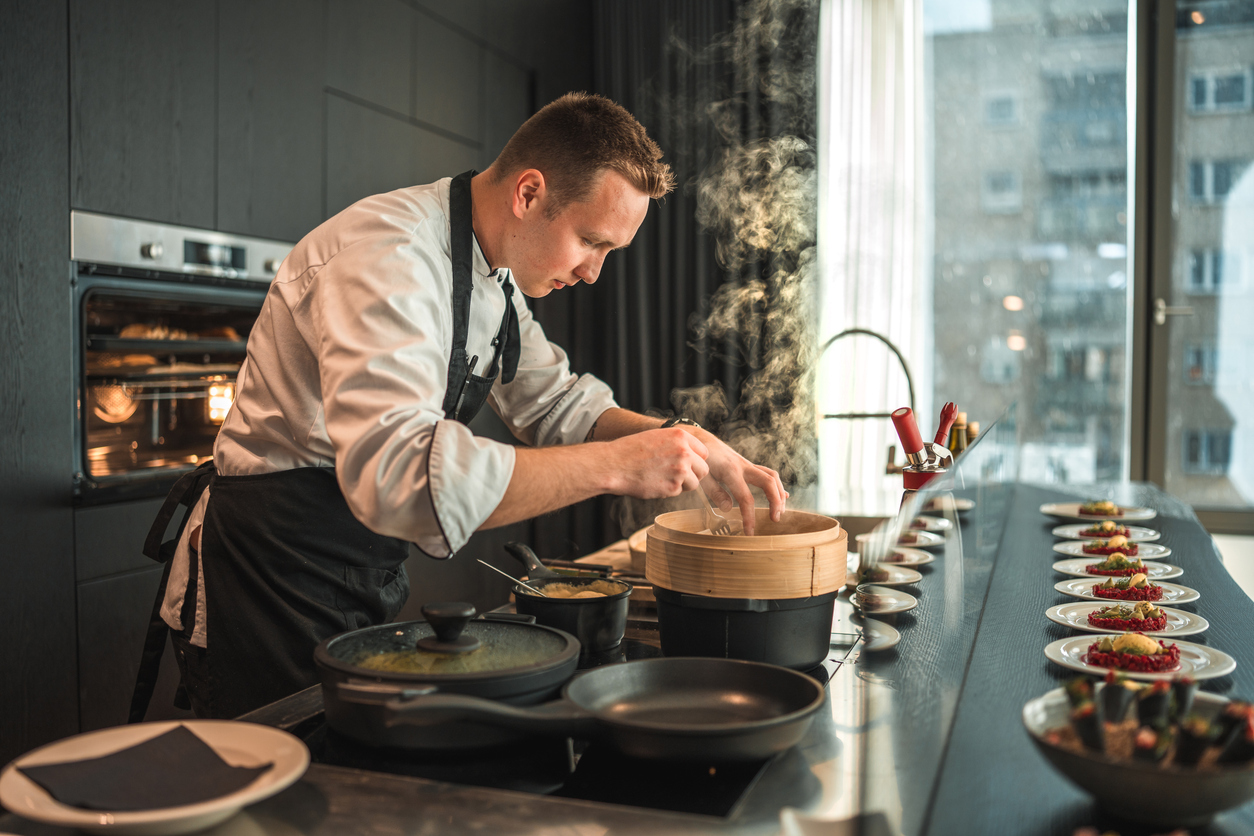
Becoming a self-employed private chef offers a different way to practise your profession: working directly with clients, cooking in private settings and enjoying greater freedom when designing menus. However, turning culinary expertise into a professional business requires more than cooking skills. You must define a clear offer, organise your services, establish appropriate prices and develop your visibility.
Here are the main steps involved in building a consistent and sustainable private chef business.
1. Understand the role of a private chef
A private chef prepares meals in a client’s home for a private or professional occasion. Depending on their positioning, they may offer fine-dining experiences, family meals, corporate events, cooking classes or regular culinary services.
Their role may include menu creation, ingredient sourcing, preparation, cooking, plating, service and leaving the kitchen clean and tidy. It is therefore important to explain clearly what is included in each service.
A private chef remains an independent professional. They organise their own activity, choose their clients and remain responsible for their commitments, prices and quality of service.
2. Define your positioning
Before looking for clients, you need to determine what makes your offer distinctive and easy to understand.
A professional may specialise in fine dining, relaxed gatherings, pastry, plant-based cuisine, private events, cooking classes or recurring culinary services.
Clear positioning makes communication easier. It also helps clients quickly understand whether the professional matches their event, budget and expectations.
To define your positioning, consider the following questions:
What kind of experience do you want to provide? Which clients do you want to serve? How many guests are you prepared to cater for? Which geographical area can you cover? Which types of service do you genuinely master? What image do you want your business to convey?
The objective is not to offer every possible service. It is to present an offer that is consistent with your experience, skills and organisation.
3. Build your services and menus
A service should be clear enough for the client to understand and imagine the experience.
Each offer can specify the type of experience, accepted number of guests, menu structure, included services, starting price and any staff or equipment requirements.
Menus should also reflect the professional’s identity. A few well-designed options are often more convincing than a long and confusing list.
It is equally important to anticipate allergies, dietary requirements, limitations in the client’s kitchen and the practical conditions required to deliver the meal successfully.
4. Set consistent prices
The price charged by a private chef does not only represent the time spent in the client’s home.
It should account for ingredients, preparation time, shopping, transport, additional staff, professional expenses, equipment and the time spent communicating with the client.
Pricing that is too low can weaken the business and create an unprofessional impression. Conversely, a higher price should be supported by experience, a strong level of service and a clearly identifiable offer.
A professional can display a starting price while providing a personalised quotation based on the menu, location, number of guests and specific requirements of the event.
5. Formalise your business
Before invoicing clients, a professional must operate under an appropriate legal structure and register their activity.
In France, business creation, modification and closure formalities are centralised through the one-stop business portal operated by the INPI. The choice between a sole proprietorship, micro-enterprise or company depends on the project, expected turnover, business expenses and the professional’s personal circumstances.
The applicable rules may vary according to the exact nature of the services provided. Professionals should therefore verify the requirements relating to registration, food hygiene, insurance, invoicing and any necessary declarations through official organisations or a qualified adviser.
Professional liability insurance is also strongly recommended when working in clients’ homes.
6. Prepare a professional presentation
Before contacting a chef, clients generally want to discover their background, cuisine and personal style.
An effective professional profile should therefore include:
A clear photograph of the professional An honest presentation of their experience Their culinary specialities Their service area Their starting prices Their services and menus Photographs of their work Their main service conditions
Images play an essential role. They should show the dishes as well as the professional at work, their techniques and the atmosphere of their events.
A precise and authentic presentation is more reassuring than vague language or an accumulation of promises.
7. Organise the client relationship
The quality of the experience begins with the first conversation.
The professional should collect all relevant information, including the date, location, number of guests, occasion, budget, allergies, preferences and equipment available at the venue.
It is advisable to confirm the menu, price, schedule, included services, payment conditions and cancellation policy in writing.
This organisation protects both the professional and the client and reduces the risk of misunderstandings before the event.
8. Find your first clients
Your first clients may come from your personal network, recommendations, social media, your own website or specialist platforms.
Word of mouth remains valuable, but it becomes more effective when supported by a visible and professional online presence.
Regularly publishing your work, requesting reviews after completed services and explaining your offer clearly can gradually help you build a strong reputation.
It can also be useful to develop relationships with event venues, concierges, companies and other complementary professionals.
9. Develop your visibility without losing your independence
A professional platform can allow a chef to present their profile, services, menus and availability while receiving enquiries from potential clients.
However, it is important to understand how the platform operates, including its subscription, commission, payment conditions, pricing control and management of the client relationship.
Chefs Unis operates without commission. Every professional remains free to set their prices, choose their services, manage their availability and decide which enquiries to accept. The client pays the selected professional directly.
The objective is to improve visibility and facilitate introductions without taking control of the chef’s business.
10. Build your business over time
Becoming a self-employed private chef is a gradual process. Your first services allow you to test your organisation, improve your menus and better understand client expectations.
Consistency, communication, punctuality and the ability to honour your commitments are just as important as culinary expertise.
Clear positioning, consistent pricing and a professional presentation provide the foundations for a business that can grow sustainably.
Are you a private chef or an independent culinary professional? Find out how to join Chefs Unis and showcase your expertise, services and menus.